

 13 January 2026
Clarity builds trust, and trust builds progress.
In the world of autism care, the path to progress is paved with collaboration. A child’s success relies on a dedicated team of parents, therapists, educators, and caregivers working in seamless harmony. Yet, even the most devoted teams sometimes hit a snag. These "snags" aren't signs of failure; they are simply communication pauses. When consistency is everything, as it is in care, small misalignments can breed frustration and slow the pace of learning.
The powerful truth? Most of these common misunderstandings are entirely preventable. By leading with awareness, empathy, and proactive communication, we can transform potential friction points into opportunities to build stronger, more trusting partnerships.
Here’s how some of the most common disconnects arise and how to bridge them before they widen:
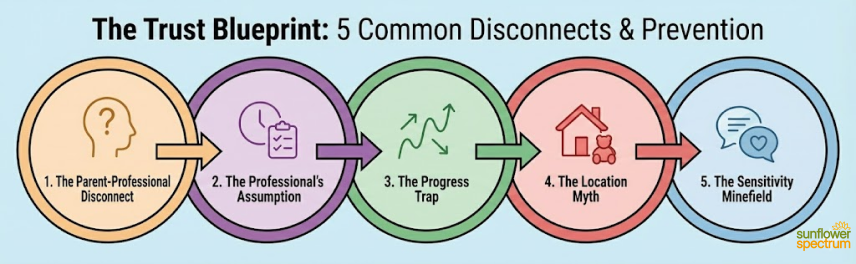
1.The Parent-Professional Disconnect
Parents are the ultimate experts on their child's personality, quirks, and history. They may sometimes feel a therapist’s approach is too generic or misses the mark on their child's specific needs.
What parents see as a lack of understanding, however, is often just the gradual, adjusting nature of therapy. A professional's method is a hypothesis they are actively testing and refining.
- Actionable Prevention: Open up the child’s world. Encourage your therapist to ask about your child's favorite motivators, unique sensitivities, and everyday strengths. If possible, invite them to observe interactions in the natural home environment. When both sides truly view the child through the other's lens, the resulting strategies become instantly more tailored and effective.
2. The Professional’s Assumption
Therapists may observe slow progress and attribute it to a lack of follow-through at home. But for a family, the issue is rarely unwillingness; it’s overwhelming. Families juggle complex schedules, emotional fatigue, and unclear instructions.
- Actionable Prevention: Prioritize practical simplicity. Professionals should replace general advice with clear, single-strategy guidance. A simple daily routine or one achievable goal is infinitely more sustainable than three simultaneous, complex objectives. Parents, in turn, must feel comfortable communicating their capacity, setting realistic expectations that lead to consistent wins instead of burnout.
3. The Progress Trap
Progress in autism care is rarely linear. There are plateaus, peaks, and seemingly backward steps. When both parents and professionals misinterpret a plateau as failure, the result is deep discouragement and a sense of stalled momentum.
- Actionable Prevention: Reframe the win. Goals must be celebrated in all forms, not just major, measurable outcomes. A calmer transition, a longer span of attention, or a new attempt at communication are some monumental steps. Regularly revisit goals together to keep perspectives balanced, motivation steady, and the long-term vision clear.

4. The Location Myth
Sometimes families view therapy as a structured, separate event, something that happens to their child, rather than something that becomes part of their life. The most profound, lasting gains, however, take root in ordinary, real-life moments during play, mealtime, or bedtime routines.
- Actionable Prevention: Blend and model. Therapists should actively model strategies that can be organically integrated into the family's daily rhythm. Families should share their child's favorite activities, helping the professional turn therapeutic principles into genuine, everyday habits. When the boundaries between center and home blur, learning becomes continuous and deeply embedded.
5. The Sensitivity Minefield
This is perhaps the most fragile point: when constructive feedback is instantly perceived as judgment or blame, trust silently erodes.
- Actionable Prevention: Agree to collaborate. Establish the rule early on: Feedback is a tool for improvement, not an act of evaluation. Ground all conversations in the shared goal, which is the child’s growth. Use collaborative language ("What if we try to adjust..." or "How can we make this work...") rather than accusatory phrasing. A tone of empathy transforms difficult conversations into meaningful steps forward.
Conclusion: Understanding Grows Where Listening Lives
Every care relationship involves a learning curve. Misunderstandings aren't obstacles; they are vital signals that communication needs more clarity and space.
When parents and therapists pause to clarify, listen without assumption, and reset with empathy, they do more than just fix a momentary problem; they fundamentally strengthen the entire partnership.
The heart of every successful care process isn't perfection, it's understanding. And that understanding begins the moment we stop assuming and start listening.
Cite this article
Stuti Sapkota (2026). The Trust Blueprint: Preventing Common Misunderstandings in Autism Care. Sunflower Spectrum. https://www.sunflowerspectrum.com/blog/the-trust-blueprint-preventing-common-misunderstandings-in-autism-care