
 16 November 2025
The teams working in autism brought thoughtful and practical innovations from AAC (Augmentative and Alternative Communication) tools to learning aids and new communication support systems for autistic individuals. This made the autism segment one of the most exciting and promising parts of the hackathon.
Nepal has taken a bold and historic step in disability-inclusive technology with AIDA 2025, the country’s first national AI for People with Disabilities Hackathon. Hosted by Prateek Innovations and proudly supported by Sunflower Spectrum by RxPIN as the Title Sponsor, the four-day residential event gathered young creators, disability advocates and technologists with one unifying purpose: to build tools that make life more accessible for people with disabilities and foster a society that understands both visible and hidden disabilities.
For Sunflower Spectrum, this was more than an event. It was a moment of meaningful progress. It reaffirmed the belief that empathy, innovation and lived experience can come together to create real change for Nepal’s disability and neurodivergent communities.
A Hackathon Rooted in Representation and Purpose
More than 30 teams from across the country applied, and seven were selected based on vision, clarity of problem, feasibility and commitment toward long-term impact.
The event held true to its inclusive foundation. Four participants were individuals with disabilities, actively shaping the design and testing of prototypes. Nearly 40 percent of participants were women, making AIDA 2025 one of Nepal’s most diverse, representative tech events to date.
Teams worked under four key themes:
- Smart mobility and communication
- Assistive AI for autism
- Digital caregiver support systems
- Educational tools for hearing and speech-impaired learners
Throughout the journey, mentors who work on the ground with disability communities provided guidance rooted in real lived challenges rather than assumptions. Their contributions ensured the solutions were not only creative but genuinely useful.
From Concept to Prototypes with National Visibility
All teams first participated in a virtual ideathon. Judges from Monal Tech, Diyo AI, NAPD Nepal, Kathmandu Metropolitan City and King’s College evaluated the entries based on social impact, clarity of problem, innovation and team capability.
The top seven teams then entered the final 36-hour build phase at Sunway College. Many of these prototypes later made it to the ICT Awards 2025 Startup and Ideafest, giving students a national platform to share their ideas and raise awareness on disability-inclusive technology.
Judges Who Shaped the Vision
The Grand Finale on 15 November 2025 was evaluated by an accomplished jury representing academia, technology, design, business and disability advocacy. Their insights strengthened the teams’ work and elevated the seriousness of the event.
Final Jury Panel:
- Dr. Bal Krishna Shrestha, Kathmandu University School of Education
Assessed educational value, user accessibility and long-term learning impact. - Himal Gautam, Founder of One Point
Evaluated user experience, problem definition and practical implementation. - Anish Shrestha, Co-Founder of Viewfinders and senior member at Leapfrog
Reviewed technical feasibility, AI integration and prototype quality. - Dhurba Adhikari, Founder of RxPIN
Focused on real world applicability in autism, disability care settings and ensured accessibility remained central to every idea.
Their combined expertise helped ensure that the winning projects were not just innovative, but meaningful and scalable.
Celebrating the Winners and a Bright Future for Assistive AI for Autism
AIDA 2025 ended with strong outcomes, particularly in the Assistive AI for Autism category.
The teams working in autism brought thoughtful and practical innovations from AAC (Augmentative and Alternative Communication) tools to learning aids and new communication support systems for autistic individuals. This made the autism segment one of the most exciting and promising parts of the hackathon.
- Team Synaptic, representing Assistive AI for Autism, won the Best Innovation Award for their forward-thinking solution.
- Mission Chaurasi, also in the autism category, secured First Runner Up with a deeply impactful idea that addressed communication challenges faced by autistic learners.
This is a powerful indicator of what lies ahead for autism support in Nepal. The creativity, empathy and technical clarity shown by these teams signal a bright future where AI-powered tools can help autistic individuals thrive, communicate and access more opportunities.
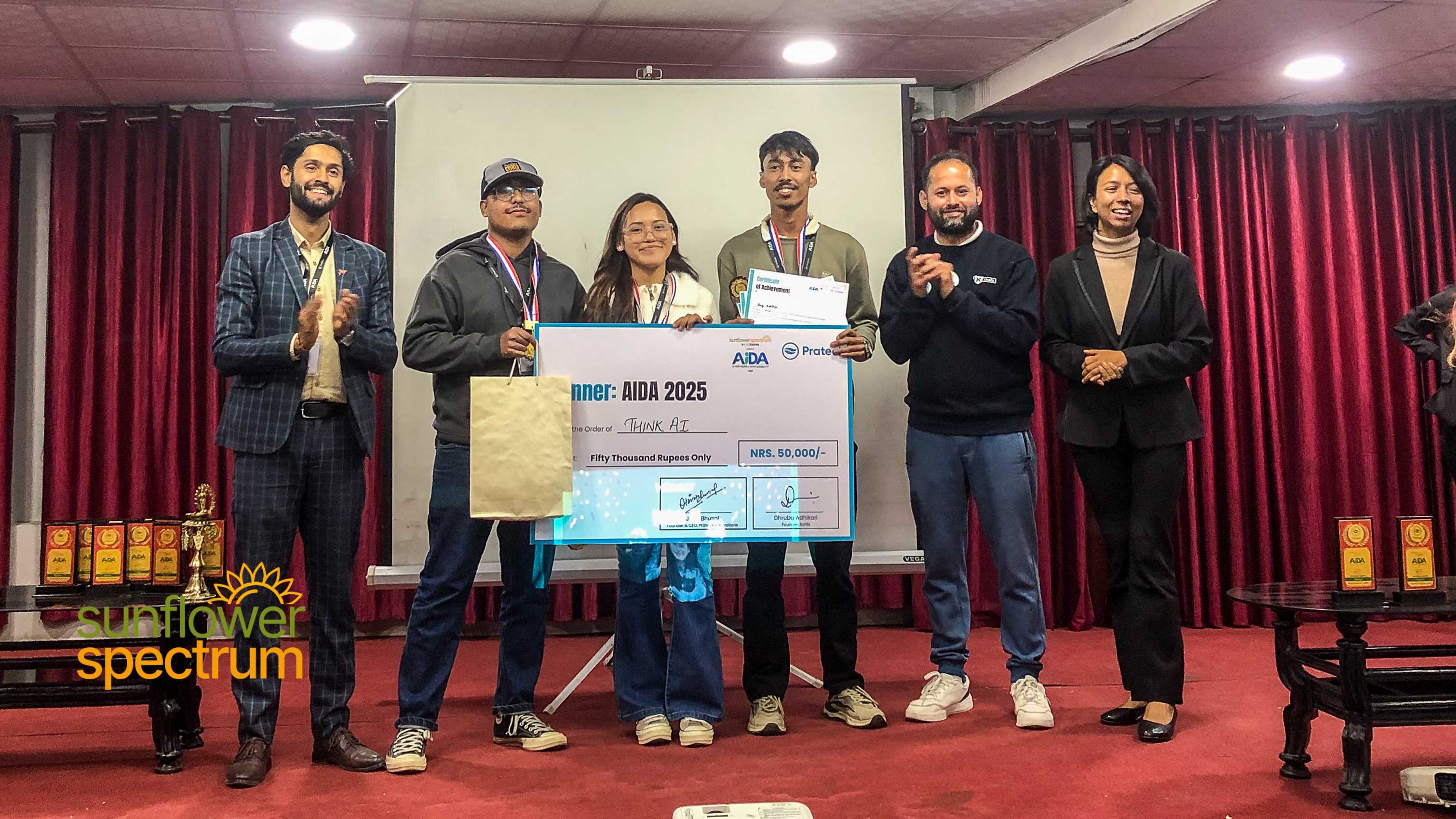
The top prize winners were announced as follows:
- First Place: Think AI
Cash Prize: NPR 50,000 - First Runner Up: Mission Chaurasi
Cash Prize: NPR 30,000 - Second Runner Up: Access Code
Cash Prize: NPR 20,000 - Best Innovation Award: Team Synaptic
Cash Prize: NPR 20,000
Sunflower Spectrum will soon publish an exclusive interview with Team Synaptic and Mission Chaurasi to highlight their journey, motivations and the purpose behind their autism-focused innovations.
Beyond Awards: A Movement is Born
The impact of AIDA 2025 stretches far beyond the prize ceremony. The top 16 teams from the initial applicant pool will now enter an incubation screening process. This next phase will help refine their ideas, connect them with industry experts and open doors for long-term project development.
The Event Director and Founder of Prateek Innovations, Jatin Bhusal, has already announced plans to host AIDA every year and is preparing Nepal’s first International Conference on AI for People with Disabilities in 2025.
A Future Where Everyone Belongs
AIDA 2025 proved that Nepal is ready to lead with compassion, creativity and purpose. It showed that disability inclusion is not a distant dream but an achievable reality when empathy and technology work together.
For Sunflower Spectrum by RxPIN, this event reflected the core mission we stand for. We are building a movement that advances disability awareness, supports autistic and neurodivergent individuals and encourages technology that includes everyone.
AIDA 2025 is only the beginning. And together, we are shaping a future where every person is seen, supported and empowered.
Cite this article
Anurag Sharma (2025). AIDA 2025: Nepal’s First AI for Disability Hackathon Marks a New Dawn for Inclusive Innovation. Sunflower Spectrum. https://www.sunflowerspectrum.com/blog/aida-2025-nepals-first-ai-for-disability-hackathon-marks-a-new-dawn-for-inclusive-innovation