
 3 November 2025
The Global ABA Summit was a pivotal moment of clarity and resolve. Nepal now holds a comprehensive roadmap, blending political will with scientific rigor, ensuring that the country’s journey toward inclusivity and professional behavioral health services is sure and steady.
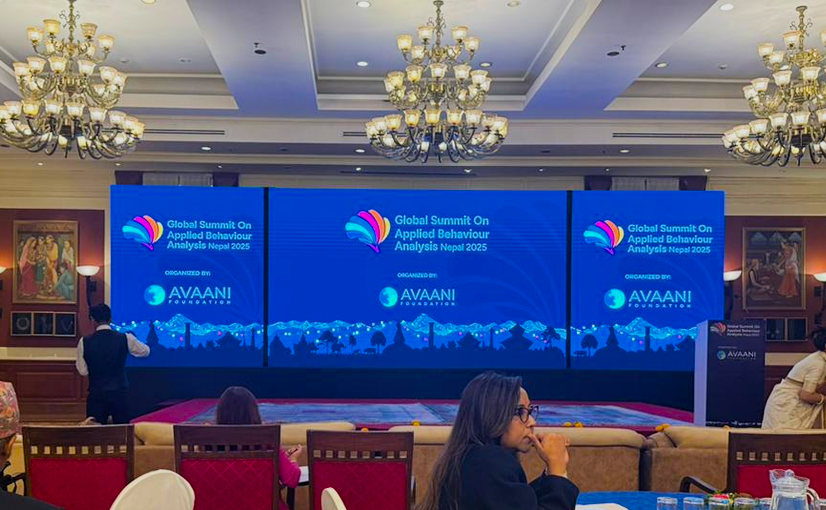
Kathmandu, Nepal—The inaugural Global Summit on Applied Behavior Analysis (ABA), held on October 29-30, was a landmark event that transcended a traditional conference format. Organized by the Avaani Foundation, the summit fused rigorous behavioral science with deeply personal advocacy, sending a clear, resounding message: Nepal is ready for a professional, regulated, and compassionate system of behavioral care. The event established a firm foundation, showing Nepal to be slowly but surely moving in the right direction.
The Human Heart of the Science: Avaani’s Testimony
The most powerful moment of the summit was the opening address, which put the life-changing potential of ABA on full display. Mrs. Pragya Shrestha Pradhan, BCBA, founder-Chairperson of the Avaani Foundation and the nation's sole Board Certified Behavior Analyst, presented compelling, data-backed papers showing how ABA has transformed the lives of children with ASD.
This professional evidence was instantly humanized by her daughter, Avaani, who lives with ASD, giving the opening speech. Avaani's successful address was a profound and visible testament to the efficiency of ABA in intervention, providing every parent and professional in attendance with tangible proof of the science's transformative power in developing communication and life skills.
The fact that Mrs. Pradhan was the only Board Certified Behavior Analyst (BCBA) from Nepal on the stage, highlighted the significant lack of human resources in this field within the country.
The Path to Professionalization: Dr. Neil Martin’s Blueprint
The summit's second day focused on the necessary infrastructure for national advancement, guided by global experts. Dr. Neil Martin, a behavior analyst since 1990 who has assisted multiple nations in developing professional behavioral infrastructure, provided the essential blueprint for Nepal’s path forward.
Dr. Martin affirmed that the professional elevation of ABA requires consensus and regulation:
- Regulation First Requires Professional Recognition: Establishing ABA as a distinct group of professionals is paramount.
- Agreed National Standards: Professional recognition must be built on clear, consensus-driven standards.
- Professional Infrastructure: This includes the availability of university training to solve the critical human resource shortage.
This message resonated with Nepal’s own leaders:
- Government Commitment: The presence of the Joint Secretary of the Ministry of Education and the Additional Secretary of the Ministry of Health confirmed the government’s pledge to building a better care system and heading towards inclusivity.
- Academic Action: Prof Dr. Bal Chandra Luitel, Dean of KUSOED, provided a specific solution by outlining the university's plan to include behavior-related courses to meet the demand for human resources in the sector.
Lessons from Asia: From Malaysia to the Philippines
International speakers detailed how other Asian nations achieved professional regulation, providing Nepal with actionable models:
- The case of Malaysia showed the power of organizational advocacy, detailing the "Decade of ABA Practice" that led to the establishment of the MABA (Malaysia Association for Behavior Analysis) and the launch of the Master of ABA Coursework at Sunway University.
- The Philippines demonstrated success in community-based support with the Taguig Yakap Center, a public facility offering therapy and legislative support for children with special needs.
Modern ABA: Fun, Data-Driven, and Ethical
The summit thoroughly explored the best clinical practices, shattering the misconception that ABA is rigid or clinical.
- Joyful Intervention: Dr. Martin strongly asserted that "ABA is not therapy and should not feel clinical. It should be fun," emphasizing that enjoyment inherently reinforces positive behavior.
- The Power of Play: Dr. Smita Awasthi, founder of BMI (Behavior Momentum India), demonstrated how play is a high-level science. Backed by research and data, she showed how play-based intervention accelerates brain development, reducing the number of repetitions needed for new skill acquisition from hundreds to as few as 20-40 times.
- Skill Development: The focus was on teaching skills like Turn-Taking, Language Building, and Joint Attention, using systematic, data-driven principles such as Shaping, Transitive Motivating operations, and Prompt Fading.
- Understanding is Key: Alexa Goh, BCBA, emphasized the ethical imperative: "Comprehension comes first before addressing challenging behavior." She stressed that identifying the root cause of a behavior is essential to prevent relapse, highlighting the endless, necessary cycle of ABC (Antecedent, Behavior, Consequence) analysis.
- ABA Beyond Neurodivergence: Dr. Janet Twyman, A learning Scientist, BCBA and PHD, showcased the versatility of ABA in non-clinical settings, where Organizational Behavior Management (OBM) successfully cut employee turnover rates by half in factory settings, proving that behavior science is a catalyst for national efficiency and economic growth.
Practical Tools and Demonstrations
The two-day event provided tangible skills and broadened the scope of ABA’s application:
- The Pre-Summit Workshop with Teresa Ling, BCBA, was hailed as beneficial by students and parents alike, offering a hands-on demonstration of effective Token and Reward systems and practical use of vocal reinforcers.
- The Summit also showcased a 25-year case study by Mary Ann Panganiban, BCBA, MAOT and MAED, on how a community driven sustainable Autism system can be built.
- Rury Soeriawinata, BCBA, MSc, MEd, Presented her points on how we can build a better educational support system by individualized ABA, understanding students better rather than focusing on academics only.
A Local Ripple Effect: Advocacy on the Ground
Reinforcing the widespread dedication to this cause, representatives from RxPIN spectrum pathways were visible throughout the summit, wearing badges that read "Ask me about Autism." This active engagement, even amidst international speakers and national leaders, showcased the dedicated local advocacy that is essential to translating summit goals into everyday community support.
The Global ABA Summit was a pivotal moment of clarity and resolve. Nepal now holds a comprehensive roadmap, blending political will with scientific rigor, ensuring that the country’s journey toward inclusivity and professional behavioral health services is sure and steady.
Cite this article
Anurag Sharma (2025). Global ABA Summit Champions Data, Dignity, and a National Professional Blueprint. Sunflower Spectrum. https://www.sunflowerspectrum.com/blog/global-aba-summit-champions-data-dignity-and-a-national-professional-blueprint